Property Value Protection Program
Mill Seat Landfill Facts and Figures
Mill Seat Landfill is a state-of-the art solid waste management facility providing environmentally sound disposal services for residents, businesses, and institutions serving Monroe County and adjacent communities. Over 95% of the waste managed at the facility is generated within Monroe County. Mill Seat is a non-hazardous landfill, engineered with environmental protection systems that meet or exceed rigorous government regulations and are subject to highly regulated monitoring and reporting requirements. Systems include engineered liners and covers, leachate collection and removal, and landfill gas collection and control. A NYSDEC monitor is located onsite to oversee daily landfill operations. Monroe County is the owner and permit-holder of Mill Seat Landfill. In 2002, the County entered into a 49 year lease agreement with WM to operate and maintain the facility.
Mill Seat Landfill is located in the Town of Riga. Additional information about community benefits and the Citizen's Advisory Board can be found on the Town of Riga's website.
Facts of Interest
- Permit to Operate: New York State Department of Environmental Conservation
- Effective: May 25, 2022 through May 26, 2032
- Permitted Footprint Area: 216.9 acres
- Opening Date: May 13, 1993
- Expected Life Span: 2057
- Approved Design Capacity: 1,945 tons-per-day
- Maximum Depth of Waste at Time of Completion: 190 feet
- Renewable Energy Facility: 6.4 megawatt
Environmental Monitoring
Quarterly environmental monitoring and testing is performed under the direction of the Monroe County Department of Health. This work includes the monitoring and testing of 50 groundwater monitoring wells, two off-site homeowner wells and seven surface water sites (2 on-site storm water retention ponds and five sites in adjacent wetlands and Hotel Creek), leachate, air quality and noise.
Host Community Benefits
- Annual Payments Made During Operation Years:
- Town of Riga—minimum $450,000
- Bergen Fire Department (Maintenance and Capital Reserve Fee)
- Byron-Bergen Central School District to support environmental education efforts.
- Property Value Protection Program provided for homes located in the landfill’s immediate vicinity as of its construction permit date.
- Citizen Advisory Board (CAB) was formed to serve as liaison between the County of Monroe and the local community. The CAB meets at the landfill a minimum of four times-per-year to receive operational updates and discuss related issues.
- Water service provided to homes near the landfill plus connection to the Bergen Water System.
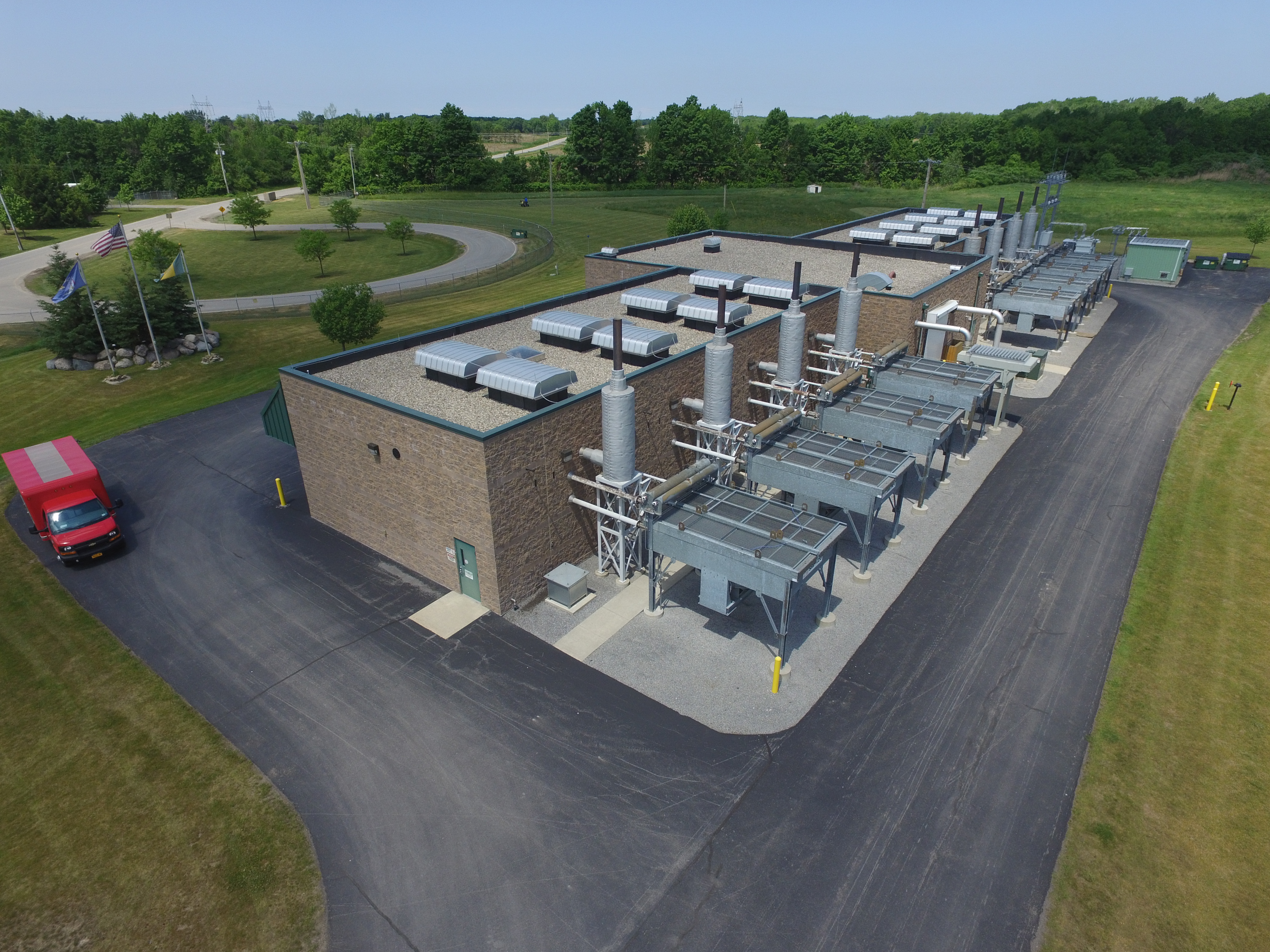 Mill Seat Landfill Gas Energy Facility
Monroe County has partnered with WM to operate the Mill Seat Landfill and produce and capture a renewable energy resource that will further move Monroe County towards greater energy independence. Mill Seat's Landfill Gas Energy Facility was opened in 2007 as a public/private partnership producing 6.4 megawatts of power by turning waste into watts through the utilization of methane gas generated from the landfill. In 2019, Monroe County transferred ownership of the Landfill Gas to Energy Facility to WM.
The 10,000 sq. ft., $9.5 million dollar facility houses eight Caterpillar 3516 engines. These engines can generate nearly 6.4 megawatts of energy - enough to power approximately 6,000 homes.
Energy is produced at Mill Seat following the decomposition of organic waste material located within the landfill. A unique facet of this project is the introduction of biosolids (sewage sludge) from the county’s two wastewater treatment plants to the landfill’s solid waste. The decomposition of this mixture enhances the production of methane gas, which is extracted and transported to the landfill gas energy facility through a series of wells and pipes. The gas is de-watered, filtered and pressurized at the facility, and is then piped to the generators, where the fuel turns the engines to produce electricity. Biosolids methane enhancement is achieved adding additional moisture and organics to the dry garbage. This process allowed Monroe County to end the costly and emission-producing practice of biosolids incineration--another environmental win.
Once the energy is produced at the landfill, it is released via transmission line into the New York power pool for redistribution. Utility companies then have the option to purchase this “green energy” from Mill Seat.
Mill Seat Landfill Expansion- Permitted in 2017
Monroe County received all permits to construct and operate a landfill expansion and support features in May, 2017.
The previously permitted footprint was 98.6 acres and the expansion added 118.3 acres of landfill footprint immediately south of the existing Mill Seat Landfill. The expansion also involved the addition of ancillary infrastructure, the abandonment of a portion of O'Brien and Brew roads, a wetland mitigation area located south of Bovee Road in the Town of Riga and a stream mitigation area in the Village of Churchville.