What we do
- Issue permits to Bathing Facilities in Monroe County.
- Enforce Subpart 6-1, Subpart 6-2, and Subpart 6-3 of New York State Sanitary Code.
- Conduct routine inspections of regulated Bathing Facilities
- Respond to Complaints of public health significance.
Bathing Facility Applications
Permit Application
Safety Plans
- Safety Plan Template for Swimming Pools & Spas (PDF / Microsoft Word Document)
- Safety Plan Template for Bathing Beaches (PDF / Microsoft Word Document)
- Safety Plan Template for Recreational Aquatic Spray Grounds (PDF / Microsoft Word Document)
- Swimming Pool and Bathing Beach Safety Plan Checklist
- Sample Brochure for Level IV Supervision facilities
Bathing Facility Modifications / Engineering Plan Review
- DOH-154 - Notice of Intent to Enlarge, Construct, or Convert a Facility
- Plan Approval Application
- Swimming Pool Plan Review Checklist
- DOH-1309 - Engineering Report for Swimming Pool Plans
- DOH-2434 - Swimming Pool Plan Review Checklist
Operation Reports
- DOH-1323 - Report on Operation of Swimming Pool
- DOH-2287 - Daily Report on Beach Operation
- DOH-4429 - Recreational Aquatic Spray Ground Operation Report
Lifeguard/CPR and CPO Certification Fact Sheets
EFFECTIVE MARCH 2023: The Department of Health is aware that several national course providers of CPR certifications now offer an option to take a course fully virtually. Department policy requires an in-person skills assessment by the instructor for a course to be accepted. Remote skills assessment will not be accepted for CPR courses of any level. CPR certification titles that offer an option for remote skills assessment will not be accepted unless the course provider establishes a means to distinguish that a skills assessment was conducted in-person. This requirement is now included in the fact sheets linked below. The fact sheets specify course titles that are impacted as well as what is required to show an in-person skills assessment has been completed.
- CPR Fact Sheet - Supervision Level III & IV updated January 2026
- CPR Fact Sheet - Supervision Level IIA, IIB, III, & IV updated January 2026
- Lifeguard Fact Sheet - Supervision Level IIA & IIB updated January 2026
- Level III Supervision for Instructional Activities updated January 2026
- Swimming Pool Water Treatment Operator updated January 2026
Contamination Response
- NYSDOH Contamination Response Recommendations for Pools and Spray Grounds
- Water Contamination Response Log (PDF / Microsoft Word)
Other Online Information
- CDC Healthy Swimming
- NYSDOH Safe and Healthy Swimming Tips
- NYSDOH - Taking Steps to Prevent Drowning
- NYS Dept of State - Uniform Code - Swimming Pools
- US Department of Justice - ADA 2010 Revised Requirements - Accessible Pools
- US Department of Justice - ADA General Website
Swimming at Ontario Beach
Beach Status & Sampling Results (Ontario Beach & Durand Eastman Beach)
Why is the Beach Sometimes Closed?
Poor water quality in the late 1960s closed the beach to swimmers. A conditional permit to operate the bathing beach was granted in 1976 after extensive monitoring and development of an Operating Model. The Operating Model currently depends upon five parameters to determine if the beach will be safe for swimming: water clarity, organic debris, local rainfall, fecal coliform bacteria levels, and Genesee River flow.
Genesee River Flow: The Genesee River is laden with particulate matter and stormwater runoff. The proximity of the River to the Beach and the volume of the River, relates closely to water quality at the Beach during certain conditions. Typically, the easterly lake current pushes the river water east, away from the beach.
Local rainfall: Local rainfall causes closures because it washes contaminants to the Beach or into local streams which impact the Beach.
Organic Debris: Organic debris in the form of decaying plant matter causes closures because it is a substrate for bacteria and sustains the bacteria by shielding ultraviolet light. Excessive algae also impair the physical water quality.
Water Clarity: Particulate matter results in poor water clarity and provides substrate for bacterial growth. It also reduces ultraviolet ray penetration that would kill bacteria.
Bacteria: Studies have shown a definite relationship between the amount of indicator bacteria in coastal and Great Lakes waters and the incidence of swimming-associated illnesses. Indicator bacteria include total and fecal coliform, enterococcus and E. coli. They are called indicator bacteria because although they may not be directly harmful to humans, they are relatively easy to test for and are typically found in the presence of harmful viruses and bacteria.
Related Documents
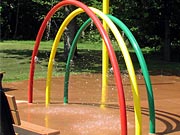 Regulations for Spray Grounds
As a result of a large outbreak of gastrointestinal illness associated with contaminated spray ground water during the summer of 2005, the New York State Department of Health released a Regulation for Recreational Aquatic Spray Grounds.
The Regulation only applies to facilities that recirculate the water supplying the spray ground.
Key provisions of the Regulation:
- Recreational aquatic spray grounds are defined and spray ground owners are required to obtain an annual permit to operate from the local health department (LHD) having jurisdiction in the county that the spray ground is located.
- Design standards for new and existing spray grounds are established. The standards include requirements for disinfection (chemical and ultraviolet) and filtration equipment, as well as requirements for spray pad, spray pad treatment tank, decking and spray pad enclosure construction and design.
- Existing spray ground operators must provide a report to the local health department (LHD) which evaluates compliance with the design criteria contained in the regulation and needed improvements. The report must be prepared by a New York State licensed professional engineer and submitted to the LHD at least 90 days prior to operation.
- Operation and maintenance standards are established including daily start-up procedures, minimum disinfection levels, filtration rates, water quality standards and general safety provisions. The spray ground operator must maintain daily operation records.
- On-site water supplies, toilet facilities, and sanitary wastewater treatment systems must comply with sanitary and operation standards.
- Spray grounds must be supervised when open for use and must be maintained by a qualified swimming pool water treatment operator.
- Spray ground operators must develop, update and implement a written safety plan consisting of procedures for patron supervision, injury prevention, reacting to emergencies, injuries and other incidents providing first aid and assistance.