November 10th, 2026
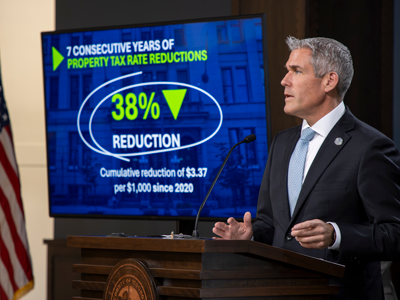
Reduces tax rate for seventh consecutive year, bringing it to a historic low
Continues to fund priority programs and services in spite of growing federal and state unfunded mandates
View 2027 Proposed Budget (PDF)
Monroe County Executive Adam Bello today submitted his 2027 budget proposal to the County Legislature. The roughly $1.6 billion proposal is a disciplined financial plan that reduces the property tax rate by $0.25 to a historic low of $5.42 per $1,000 of assessed value. This is the seventh consecutive tax rate reduction by the Bello administration. In total, County Executive Bello has lowered the County property tax rate by $3.37 per $1,000 assessed value since taking office in 2020.
The proposed budget complies with the Monroe County Taxpayer Protection Act and stays below New York State’s property tax cap, while holding growth in the operating budget to 3.4%, below the rate of inflation. This year’s spending plan prioritizes fiscal stability, protects taxpayers, and invests in critical services that residents depend on, despite growing unfunded mandates from the federal and state governments.
“My proposed 2027 County budget lowers the County tax rate for the seventh consecutive year, keeps spending growth below the rate of inflation, and maintains my commitment to fiscal responsibility. It invests in programs and services our residents rely on, and brings needed financial relief to county taxpayers,” said County Executive Bello. “However, we continue to face growing financial pressure from unfunded federal and state mandates, and rising costs of pensions, healthcare, and operating County government. These growing obligations put increasing pressure on County taxpayers and are simply not sustainable over the long term. Despite that, I am committed to managing those challenges responsibly, protecting taxpayers, and making strategic investments that strengthen our community and improve the quality of life for the people who live here.”
The County is able to reduce the tax rate in part because of rising property values in Monroe County, resulting in about 8% of assessment growth in the towns and city of Rochester. This means County government can reduce the tax rate while maintaining the tax levy needed to support the essential services and programs that residents have come to expect and depend on.
Even with increased support from property tax revenue, cuts in federal aid, paired with unfunded mandates from both the New York State and federal governments, continue to shift costs onto County government, resulting in structural budget challenges. Unfunded mandates have risen dramatically since Bello took office in 2020.
Federally-mandated costs:
- Supplemental Nutrition Assistance Program – the federal government’s share of administrative costs is decreasing from 50% to 25%, meaning approximately $4.3 million in additional County costs
- Monroe Community Hospital- as the cost of providing care continues to rise, Medicaid reimbursements are not keeping pace. In 2020, County operational subsidies at MCH were $2.5M; in 2027, they are $16.8M, a 573% increase.
New York State-mandated costs:
- Early Intervention and Preschool Education: Since 2020, County costs for this NYS-mandated program have increased from $19.2M to $40M, a 107% increase.
- Mental health competency hearing beds: Since 2020, NYS has reduced its share of this mandated program from 50% to 0%, increasing County costs associated with it from $3.5M in 2020 to $11.3M in 2027, a 223% increase.
- Employee pension costs are projected to reach $66.6M in 2027, compared to $34.7M in 2020, a 92% increase.
- In addition, persistently rising costs in areas such as contractual services and supplies, and employee healthcare also create ongoing challenges in the County’s budget.
- Employee health insurance: In 2020, County costs were $65.6M; in 2027, they are $112.1M, a 71% increase.
These unfunded mandates and rising contractual obligations require the proposed budget to utilize a portion of the County’s fund balance. Sound budgeting practices since the beginning of the Bello administration have resulted in a healthy fund balance that can be utilized in years that require it, like this one. The proposed 2027 budget includes the investment of $33M of general fund balance to address some of these challenges, a decision that is made carefully and in line with previous years’ projections, and one that results in the investment in vital County services and programs that focus on the well-being, health, and safety of our community.
For working families, access to affordable, quality child care is often too expensive and out of reach. This year, Monroe County was selected by New York State to be the site of an expanded universal childcare pilot program. The budget reflects $22M from New York State and a $2M investment from the County for the “First Three” NY Child Care pilot program, administered by the Department of Human Services, that will add 1,000 child care slots for Monroe County families with children ages 0-3 years old, regardless of income or resources.
The budget dedicates resources to programs that uplift people in the community and prepare them for a stronger, more stable life. Although opioid deaths are trending down, opioid harm reduction work continues, as does prevention and recovery support initiatives. The 2027 budget invests $4.6M in appropriations for the Department of Public Health’s Opioid & Addiction Services Task Force from the opioid settlement trust fund to continue work on these initiatives. In addition, the Office of Mental Health’s budget includes $2.7M for related addiction services work, including a new commitment to Project Ride- previously supported by the American Rescue Plan Act (ARPA)- a program that supports individuals at a stage in their recovery where they are able to engage in full time, independent work but transportation is the primary barrier to entering or remaining in the workforce.
Programs that serve veterans and older adults remain a priority for the County Executive. In early 2025, the County’s Veterans Service Agency and Office for the Aging partnered with Lifespan to open satellite offices with ARPA funding where staff have assisted nearly 7,000 of our residents to date. In the absence of that ARPA funding in this budget, those offices will continue to be supported, this time with County dollars. While locations will soon move to the Greece Public Library and the East Rochester Town Hall to better accommodate residents, the focus will continue to be on making support and resources as accessible as possible for our veterans and older adults.
The Monroe County Legislature will consider the spending plan for adoption at its meeting on December 8.